
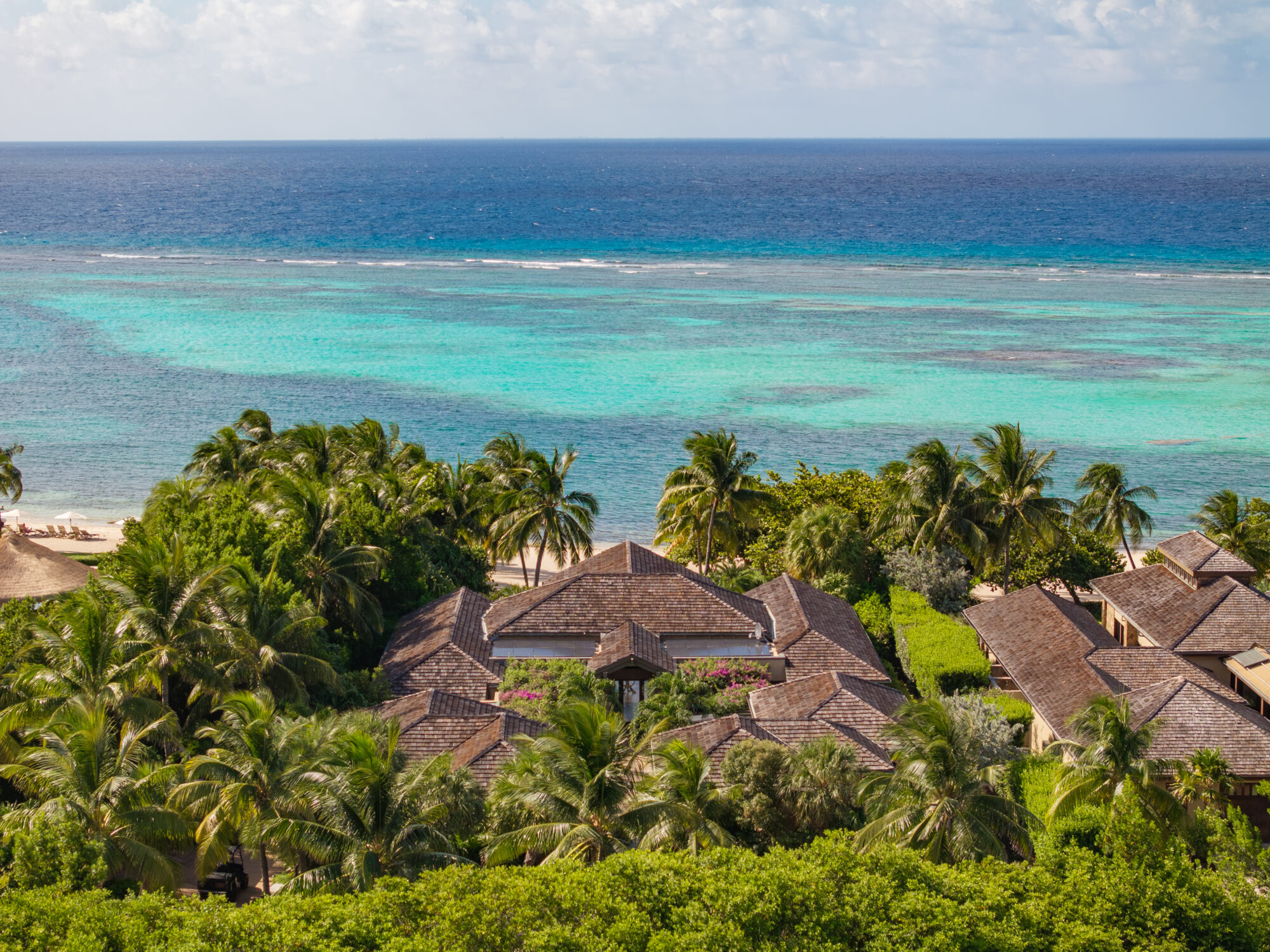
In one of the world’s most difficult places to build, a fully furnished beachfront villa asks nothing of its next owner beyond showing up.
By Chris Caggiano
Building a home on Virgin Gorda can be slow. Every plank, every fixture, every piece of furniture has to travel by boat or helicopter to reach Oil Nut Bay, the private enclave on the island’s northeastern tip. It is precisely this challenge that makes the enclave what it is: a small, tightly held community of oceanfront homes on the British Virgin Islands, where owners sometimes spend years getting their interiors just right.
Against that backdrop, Ohm at Oil Nut Bay stands apart not because it promises seclusion or beauty, both of which are baseline expectations here, but because it has already resolved the one problem that defines building in this place. It is complete. Offered fully furnished at $24 million, the six-bedroom villa asks nothing more of its next owner beyond showing up.
That completeness is not incidental to the design; it is the design. “You walk in and everything’s there, down to the last detail,” says listing agent Mike Fabbri of The Agency. “You just bring your toothbrush and your private chef.” Fabbri jests, of course, but he captures something real about what the sellers set out to do: remove the friction of ownership so completely that the only thing left to experience is the place itself.
The Sound of Water
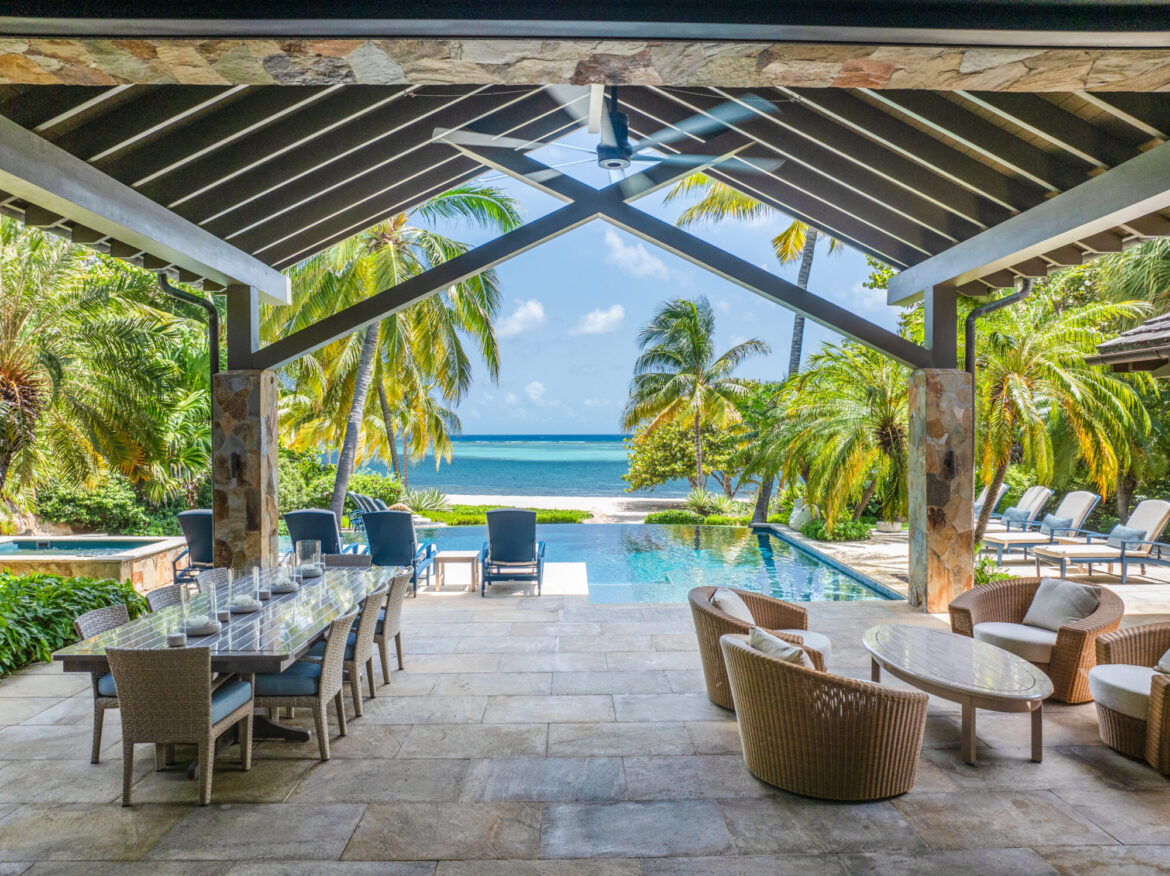
Every room at Ohm carries the sound of moving water, a detail that gives the property its name. An acoustic waterfall feeds the property’s infinity pool, and its presence is audible throughout the house, layered against Teflon-coated linen walls designed to absorb sound, keeping the interior calm even as the ocean moves just beyond it. The effect is less architectural flourish than organizing principle. “There’s a natural flow to the home, and in every room you can hear the sound and movement of water,” Fabbri says. “Every detail creates a sense of ease.”
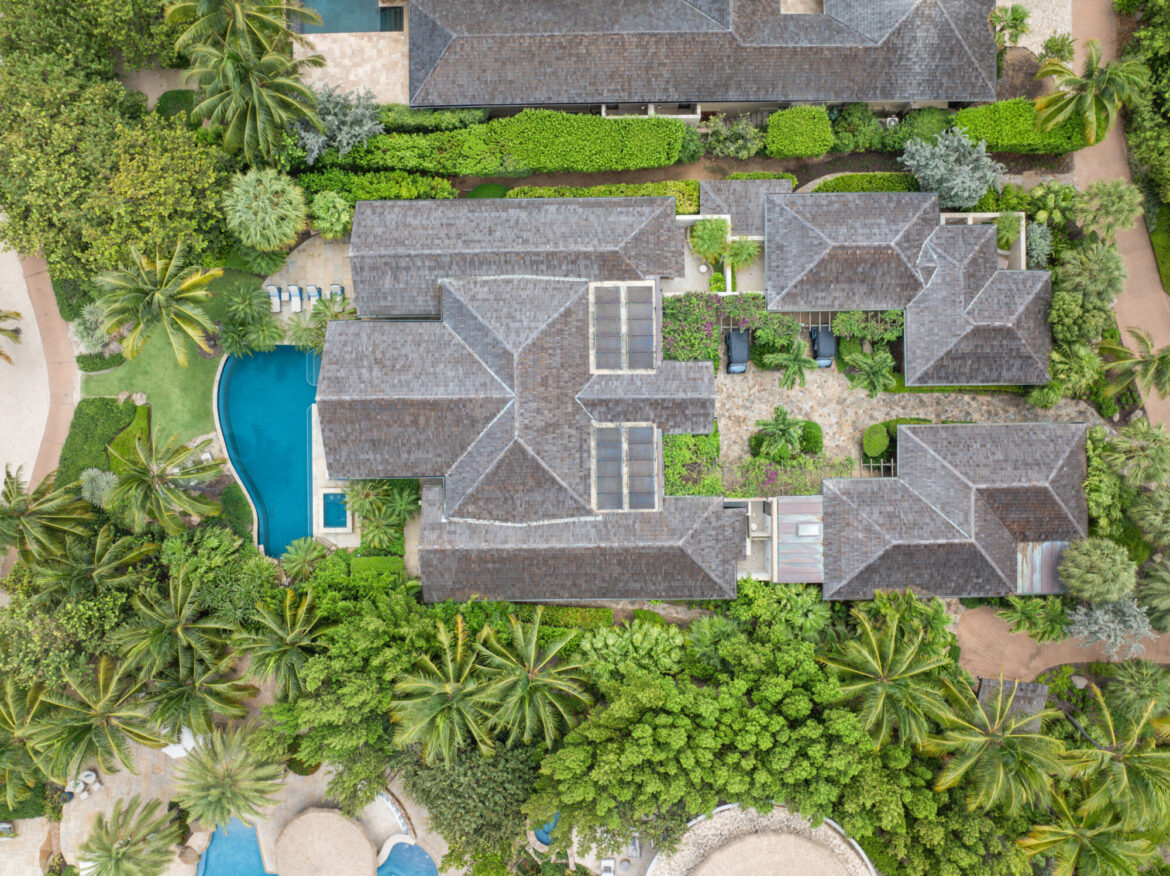
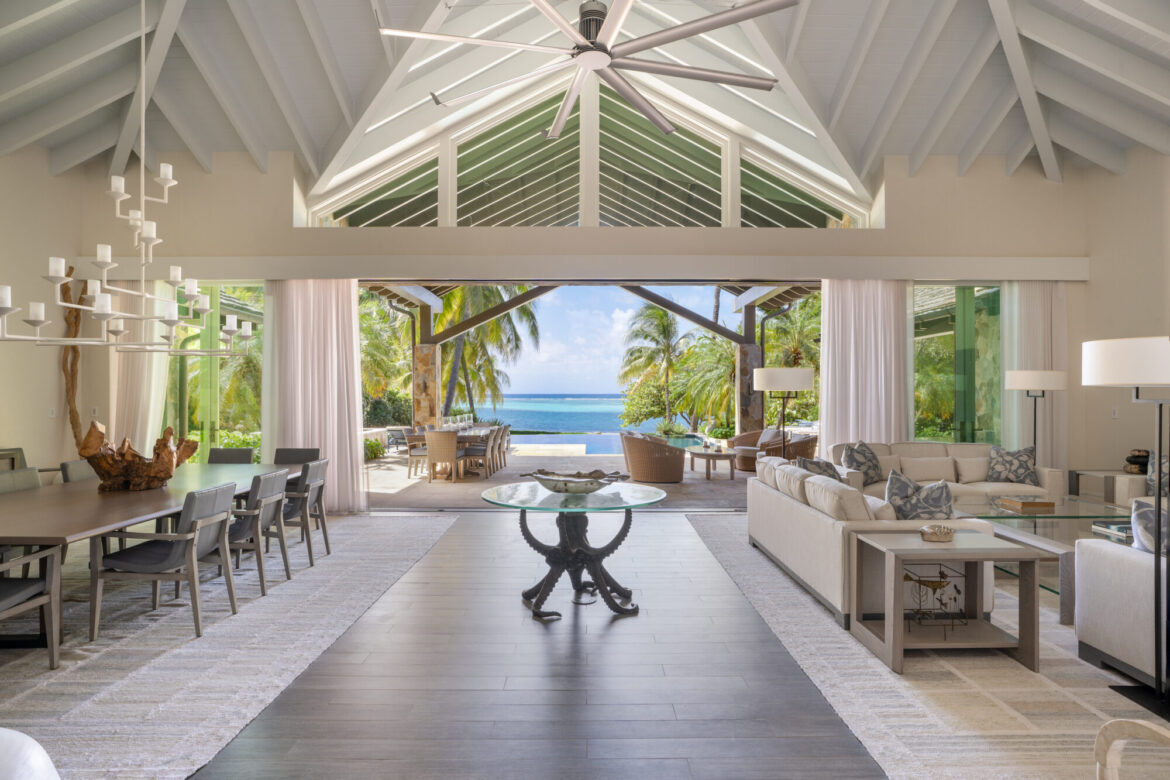
That sense carries through the floor plan itself. Rebuilt from the ground up and reimagined in full, the villa is shaped in a gentle U around a private courtyard, with the main living and dining pavilion opening directly onto the water. Wood-look porcelain floors and custom furnishings keep the interior warm rather than austere, a choice that lets the turquoise view do most of the visual work. Sliding glass walls fold away entirely, so the boundary between the pavilion and the beachfront terrace all but disappears, and daily life in the house shifts easily between the two without anyone having to decide where indoors ends.
A Series of Suites
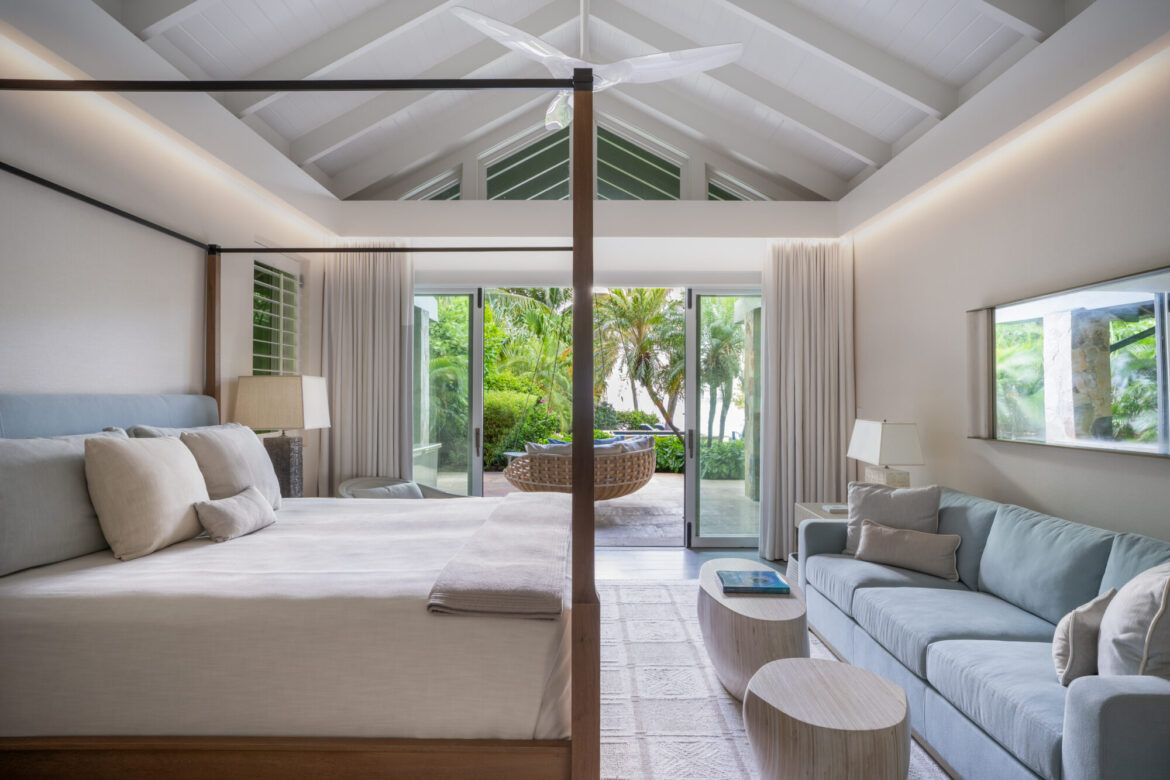
The villa’s six bedrooms are each en suite, with double walk-in closets and dual vanities throughout, and five of the six open onto private outdoor showers set into the landscaping rather than tucked against a wall. Two of the suites are configured as primaries, each positioned to capture its own sweeping water view, which gives owners real flexibility in how they use the house from one visit to the next rather than defaulting to a single fixed hierarchy of rooms. The primary suite can also be locked off entirely, allowing the villa to function as a five-bedroom retreat while preserving a fully private owner’s suite.
A separate staff or guest suite, along with dedicated service areas, a full laundry room, and generous basement storage, occupies its own wing. The arrangement is a practical one: it lets the home operate seamlessly for a family gathering or a full house of guests without any of that activity intruding on the main living spaces. A dedicated chef’s kitchen, separate from the family kitchen used for daily meals, is positioned discreetly enough to support large-scale entertaining without disrupting the quiet of the rest of the house. A media room finished in the same sound-absorbing materials rounds out the wing’s amenities, giving the household its own quiet, self-contained rhythm apart from the main living spaces.
Where House Meets Beach
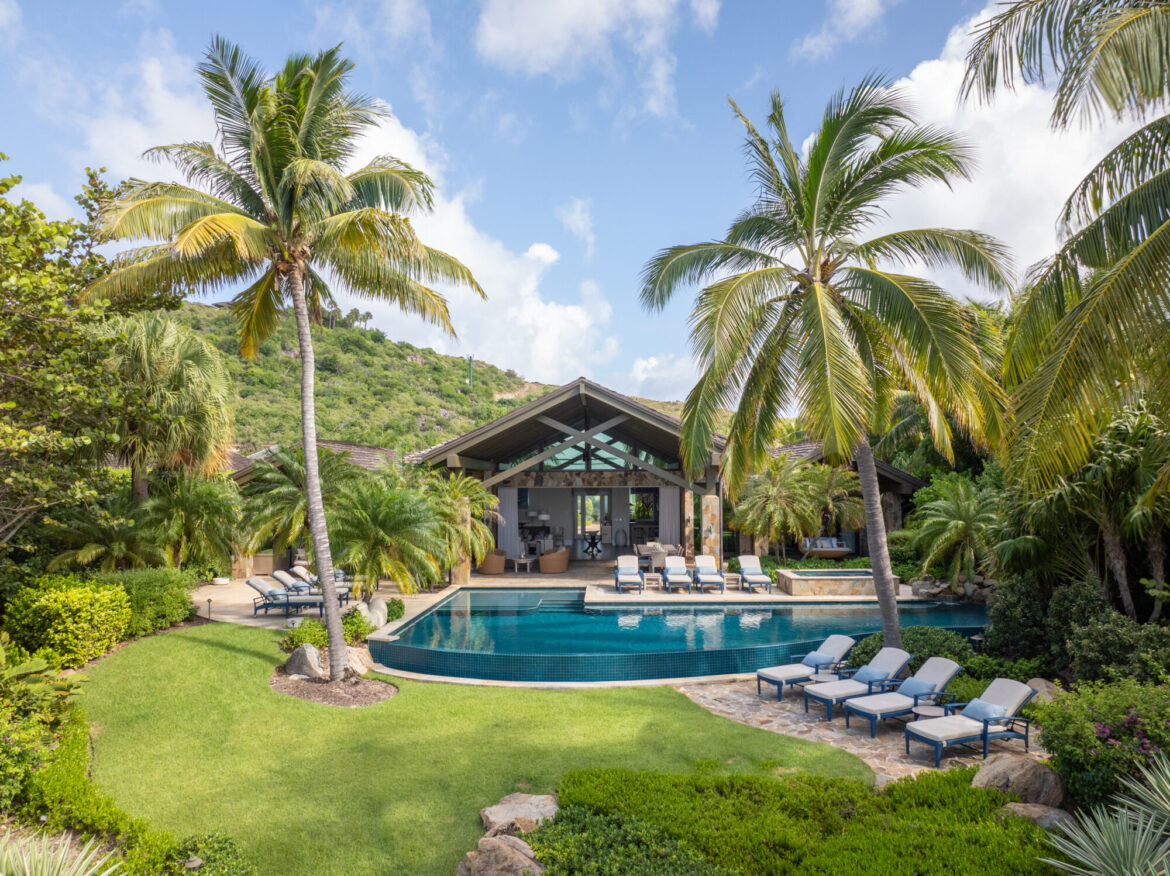
Outside, a broad terrace holds a heated infinity pool and hot tub, with shaded lounge areas that lead directly onto the sand. The lawn continues that logic uninterrupted, extending to the beach without gates, ropes, or the kind of visual signaling that would otherwise announce a property line. It is a small detail, but it is the one that most separates Ohm from its neighbors: this is one of only a handful of true oceanfront homes within Oil Nut Bay, set on a stretch of protected, calm-water cove with soft white sand.
Beyond the beach, the property includes a 30-foot private boat slip at Pier One in the Oil Nut Bay Marina and two electric island carts for getting around the community, along with extensive landscaping for privacy and a share in the community’s solar farm. None of it is ornamental. Each element addresses something a homeowner would otherwise have to arrange from scratch in a place where almost nothing arrives easily.
Seclusion and Community
Oil Nut Bay itself resolves a tension that defines a lot of ultra-private real estate: the choice between seclusion and community. With an additional membership to the nearby club, residents have access to a spa, tennis courts, an adventure center, and family-oriented facilities, all within walking distance of the villa.
“It really offers this rare duality,” Fabbri says. “Complete privacy and seclusion, but then you’re steps away from a social club.” The enclave is small enough that its handful of homeowners, many of whom are seasonal residents from around the world, tend to know one another, and rentals are managed directly through the resort rather than left open to public booking platforms, which keeps the community consistent even as guests rotate through.
Much of that consistency traces back to the enclave’s original developer, David Johnson, whose earlier communities, including Bay Harbor in Michigan, built him a following of owners who returned specifically because of his name. That reputation extends into Oil Nut Bay’s identity today, and it is part of what continues to draw buyers who already know his work.
Remote, but Within Reach
For all its seclusion, Oil Nut Bay is more accessible than its setting suggests. Travelers typically arrive through Tortola, Virgin Gorda, San Juan, or St. Thomas before making the final approach by private boat or helicopter. Virgin Gorda sits within view of Necker Island, Richard Branson’s private retreat, in a stretch of the British Virgin Islands known for drawing an international, moneyed clientele that values the same balance of privacy and polish that defines Oil Nut Bay.
Ohm’s appeal, in the end, rests on a fairly simple proposition made rare by its setting: a home in one of the most difficult places in the world to build well has already been built well, and finished, and furnished, by owners who did the work so the next ones would not have to. For a buyer drawn to Oil Nut Bay’s privacy but wary of the years it can take to make a home there truly livable, that is not a small thing. It is the whole offer.
About the Expert: Mike Fabbri is a Licensed Real Estate Salesperson with The Agency, based in New York, with expertise in Manhattan real estate and working across the brokerage’s global network.
This article is intended for informational purposes only and does not constitute legal, financial, or investment advice. The views and opinions expressed herein reflect those of the individuals quoted and do not represent an endorsement of any company, product, or service mentioned. Readers should conduct their own due diligence and consult qualified professionals before making any investment decisions.


