This 45-acre retreat outside Joshua Tree has spent the last several years quietly becoming one of the desert’s most in-demand event venues – and its next chapter could look nothing like its current one.
By Chris Caggiano
The pavement thins out past Twentynine Palms, as civilization narrows down to a single marker: the Marine base the town grew up around. After that, it’s open desert – scrub brush, distant rock formations, sky in every direction – for the better part of the two-and-a-half to three-hour drive from Los Angeles. Guests arriving by private plane skip most of that in-between entirely, touching down after a twenty-five-minute flight that trades the freeway for a bird’s-eye view of the same terrain: mountains giving way to flat desert floor, the land emptying out the closer you get to Joshua Tree.
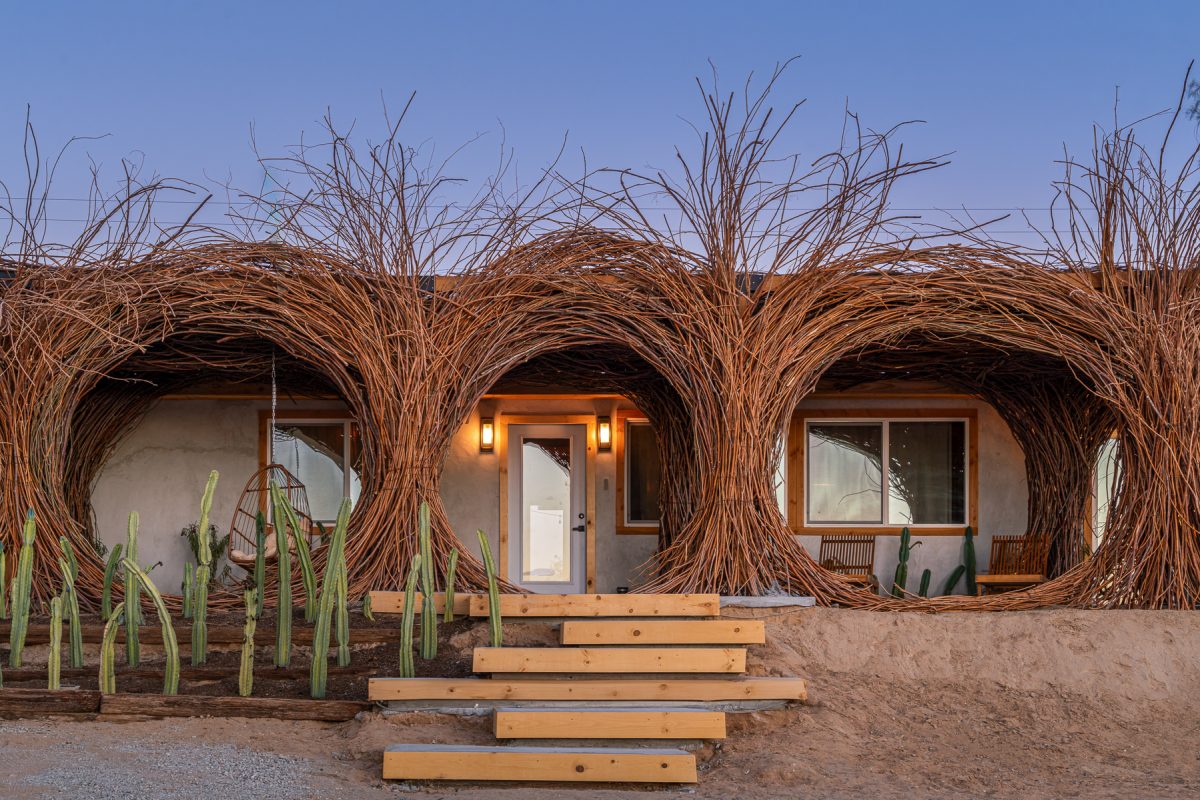
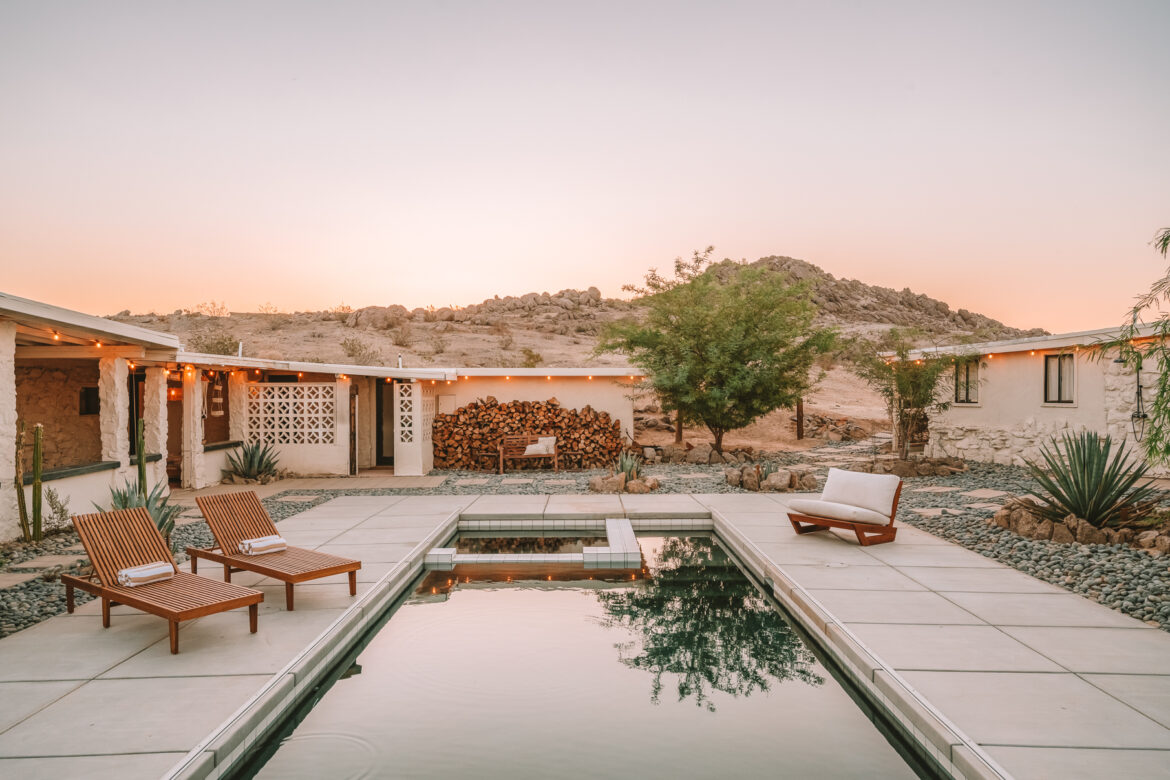
What’s waiting at the end of either route doesn’t appear to be a part of the desert around it so much as carved out of it. Forty-five acres, bordered almost entirely by federal land, unfold into six structures, two pools, a skate bowl, a dirt bike track, and a natural rock formation tall enough to serve as a wedding altar. It reads less like a single property than a small, self-contained settlement, built out of pieces assembled over years rather than a single unified plan.
From Cabin to Compound
The compound’s current owners work in motion picture advertising, producing commercials for Fortune-level brands, and split their time between the property and a home in Laurel Canyon in Los Angeles. According to Chris Webster of Webster Estates, the couple assembled Nxwhere over time out of a series of five-acre tracts – some with existing structures already in place – and then spent years layering in a look and feel he says is unlike anything else in the desert. The place has a really interesting vibe, according to Webster. “It’s mesmerizing,” he says.
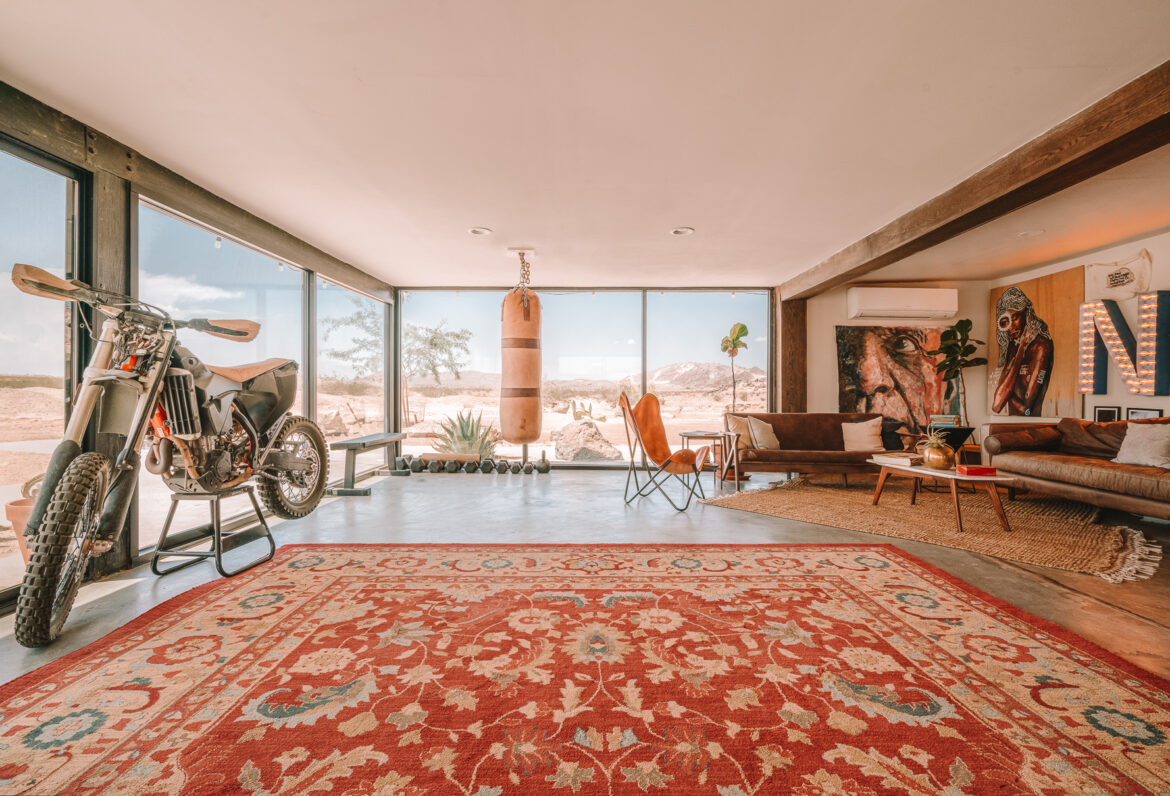
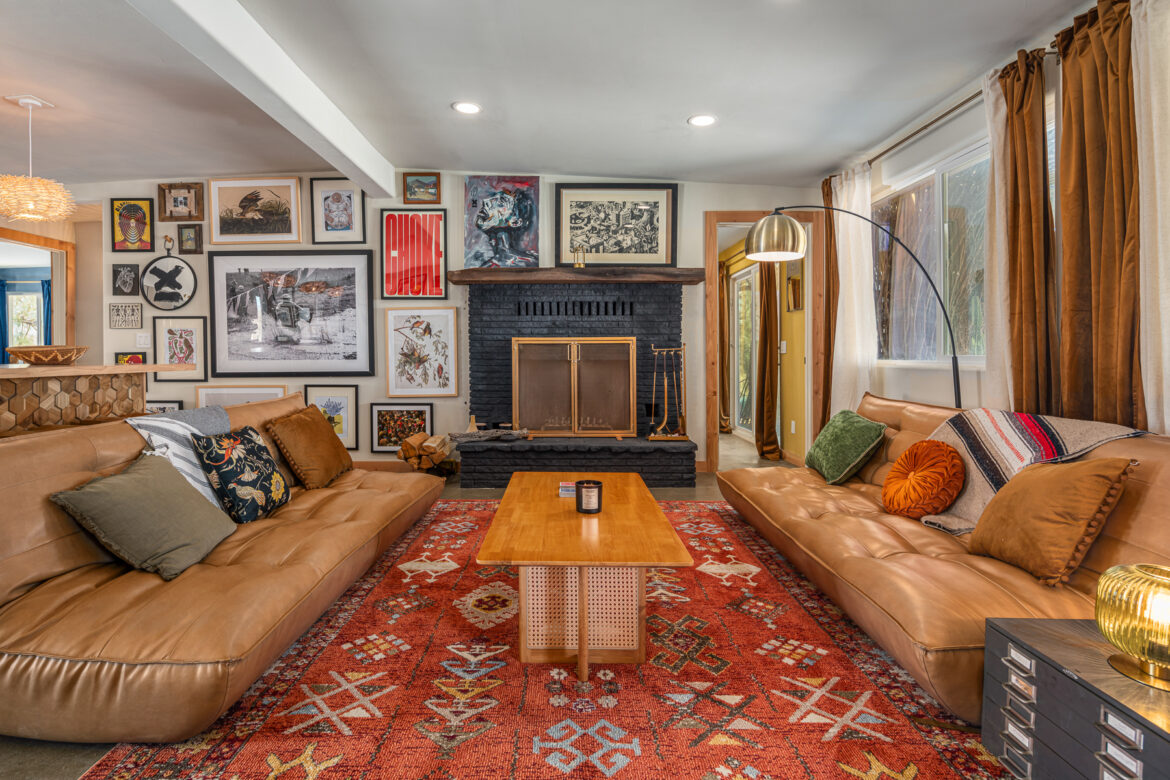
That vibe shows up most clearly in the furnishings. Rather than outfitting the six houses in a single, matched style, the owners filled them with an eclectic mix of pieces gathered over years, each structure carrying its own point of view rather than a house-wide theme. The Stone House, a fully renovated 1950s cabin, leans into that eclecticism most directly, styled with the worn, layered charm of an old bookstore. The Glass House, at 2,300 square feet, takes the opposite approach: a panoramic glass-enclosed room built for looking out at the desert rather than filling the space with objects, paired with its own fire pit and a digital projector for nights under the stars.
Of the 45 acres, roughly 20 are developed and 25 remain untouched, available for a future owner to expand the compound or take it in a different direction entirely. Together the six structures hold 17 bedrooms and 11 bathrooms. Two swimming pools, two hot tubs, a trampoline, a skateboard bowl, and a dirt bike track round out the recreational side of the property, alongside an on-site coffee shop and a storefront selling artist-designed apparel and motorcycle gear.
A Revenue Stream
Unlike a conventional estate, Nxwhere already functions as an operating hospitality brand, with guests typically booking the property mid-week through the weekend. Webster says the rental business currently brings in between $750,000 and $1 million a year, run by an existing staff that handles turnover, marketing, and event production – a business substantial enough that it comes with its own operating rhythm, not just a rotating guest list.
The client roster reflects the compound’s pull with a specific, design-forward audience: past bookings include brand activations for Rivian and American Eagle, and creative retreats tied to artists including Werner Herzog, Demi Lovato, and Brittany Howard. The property has also been featured in Vogue and The New York Times.
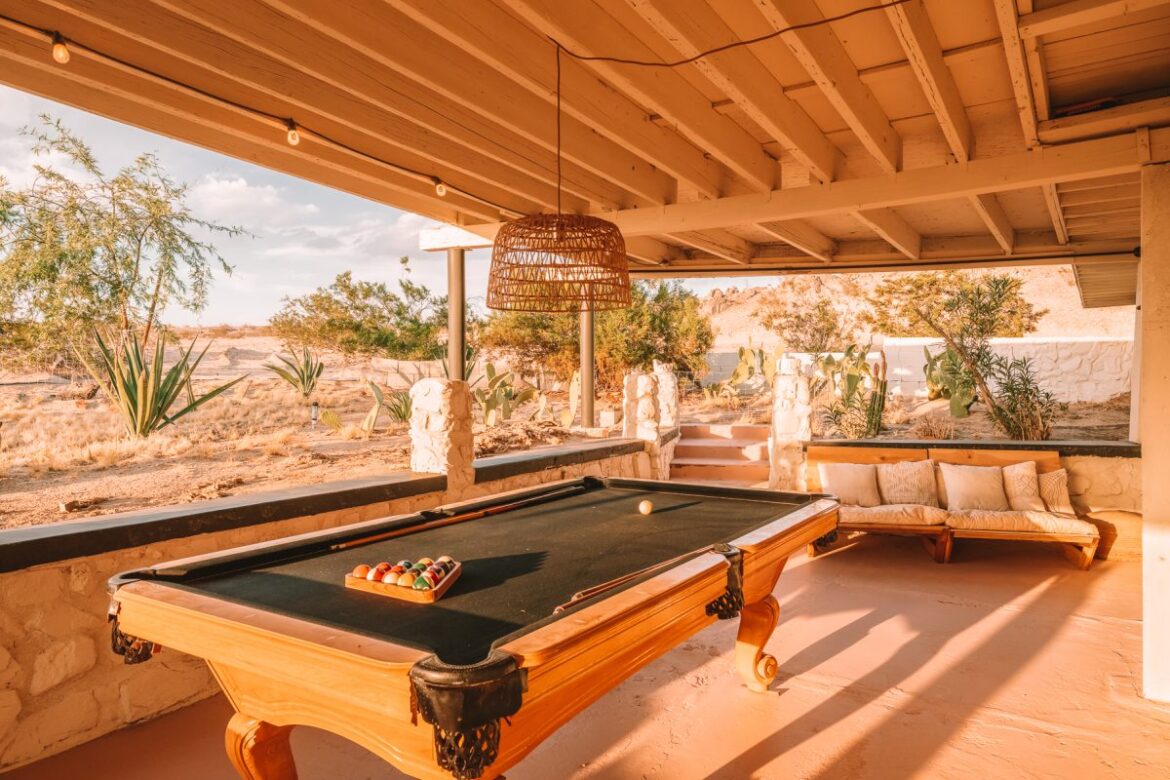
But weddings remain the core of the business, and Webster describes the atmosphere in almost cinematic terms: “They might have a band playing on the roof of one of the houses while people are dancing around the pool.” The rock formation on the property serves as a natural setting for ceremonies, and a covered, 1,400-square-foot porch handles open-air receptions.
Family reunions and corporate gatherings fill out the rest of the calendar. When a booking exceeds the property’s own capacity – it comfortably sleeps between 23 and 40 guests depending on configuration – nearby hotels, inns, and short-term rentals in the Joshua Tree area absorb the overflow.
Buffered by Federal Land
The compound’s privacy owes as much to its neighbors as to its own acreage. Nxwhere sits adjacent to roughly 220,000 acres of land managed by the Bureau of Land Management. “This is open space that’s not going to be developed,” he says, “and so it’s a huge buffer,” the kind of protection he considers a genuine value component of the property, not just a scenic backdrop. “Having the borders of your property open up into big backyards that are federally protected,” he says. “This is what most landowners and property owners consider a luxury.”
Minutes away, Joshua Tree National Park draws millions of visitors a year to its boulder fields and namesake trees. The town around it is “pretty much a bohemian, artistic, beatnik type of place,” says Webster. The area is home to people “living a creative life, to the beat of their own drums,” rather than the more conventional communities that surround most luxury properties. Art galleries and restaurants dot the area immediately around the compound, giving Nxwhere’s guests somewhere to go when they leave the property, and giving the property itself a cultural context that matches its clientele.
So Many Possibilities
Part of what makes Nxwhere unusual as a listing, Webster says, is how many directions a buyer could take it. “You could go down a half dozen different directions easily,” he says. The existing events business could simply continue as-is. Or a family could convert the compound into a private retreat. Someone in the music or entertainment industry could build a recording studio on the undeveloped acreage and turn the property into a creative production center of its own.
Webster is careful to note that the property’s value isn’t reducible to any single component – the land, the structures, the income the business generates, the furnishings that come with a turnkey sale, and the development potential in the unused acres all factor in separately.
But he points to the opportunity itself, more than any one of those pieces, as the property’s real draw: “The biggest value component is the opportunity that it presents to the person that’s going to buy it, because it fulfills a dream of what they want to do with this property, in a fashion that’s of their own making and choosing.”
About the Expert: About the Expert: Chris Webster is CEO and Publisher of Leading Estates of the World, founded in 1969 and headquartered in Santa Fe, New Mexico since 2015. He is a licensed real estate broker specializing in Santa Fe and northern New Mexico estate, ranch, and commercial properties, as well as historic haciendas in Mexico and resort properties in Hawaii and western Europe.
This article is intended for informational purposes only and does not constitute legal, financial, or investment advice. The views and opinions expressed herein reflect those of the individuals quoted and do not represent an endorsement of any company, product, or service mentioned. Readers should conduct their own due diligence and consult qualified professionals before making any investment decisions.