
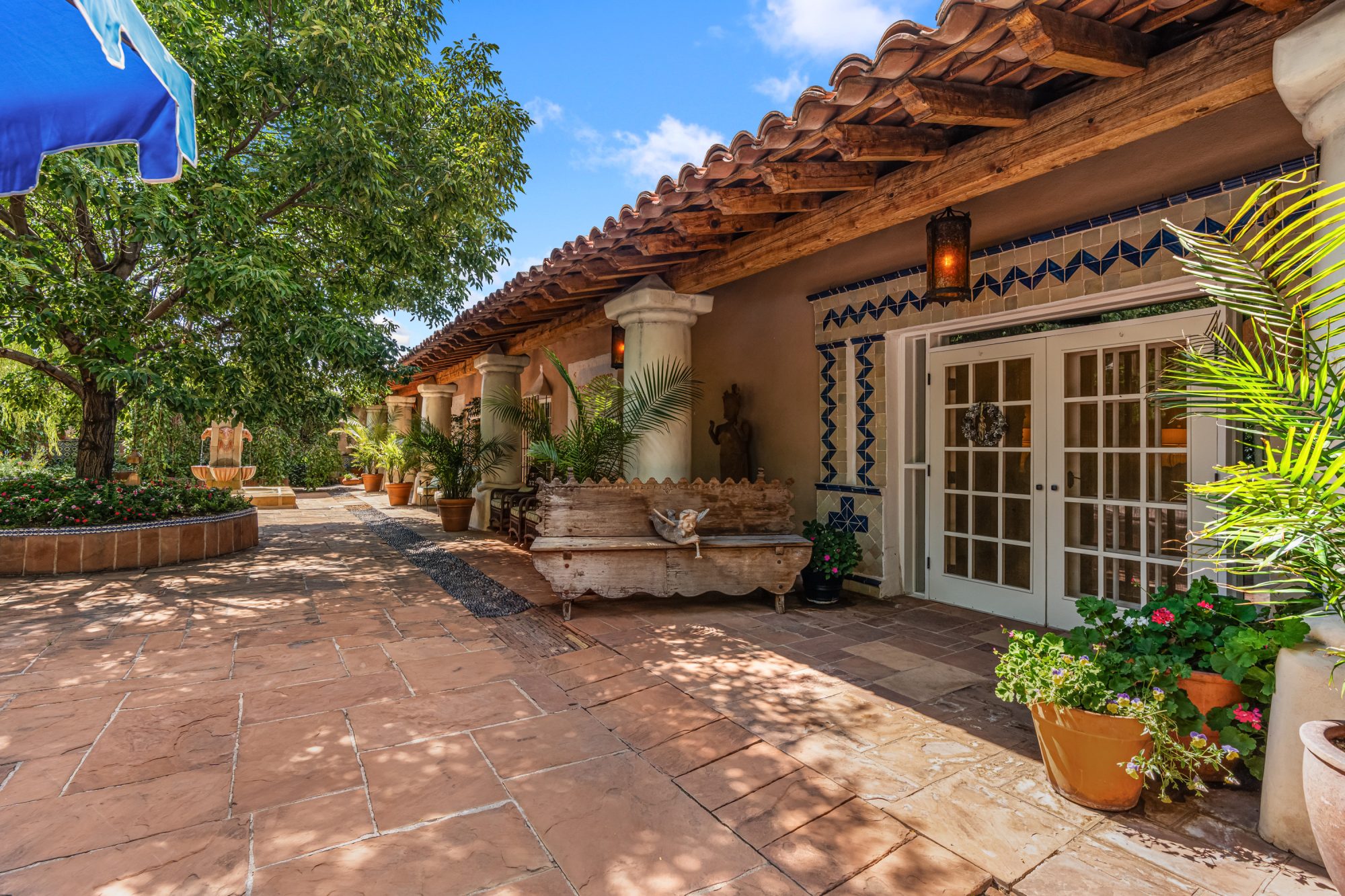
Nearly a century after an Italian architect built it beside the Santa Fe River, Cason del Triunfo has been shaped by four owners who each added their own chapter – without ever erasing the last.
By Chris Caggiano
Some houses are built once and simply maintained. Cason del Triunfo has been built five times over, by an Italian architect, a widow who lived there for half a century, and three subsequent owners who each added their own layer without ever disturbing what came before. Nearly a century after its groundbreaking, the estate on Santa Fe’s storied Upper Canyon Road still borders the Santa Fe River and is still, by local consensus, the most beautiful home in the city.
A Vision Transformed
Cason del Triunfo house was designed and built in 1935 by Giorgio Belloli, an Italian architect who had spent time working in Mexico – in the Cuernavaca area – before settling in Santa Fe. According to Chris Webster of Webster Estates, that background shows in details found nowhere else in the city: buttressed walls, a curved terracotta tile roof, murals painted on both interior and exterior surfaces, and scalloped shell-motif treatments above the living room windows. Belloli’s wife was an artist as well, and the couple’s shared sensibility is woven into the house’s earliest fabric.
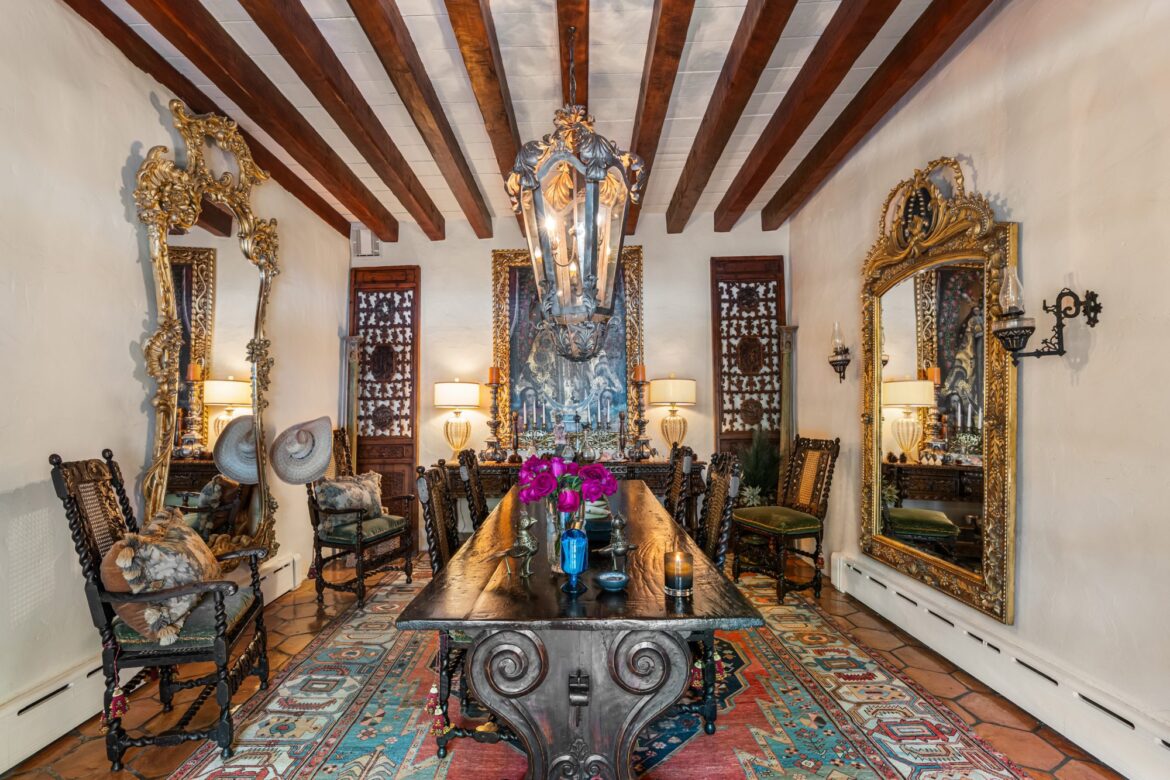
The living room ceiling beams, set closer together than is typical for the period, and the “penitentiary tile” – hollow ceramic brick made by prison labor and a common building material in Santa Fe in the 1920s through ’40s – root the house firmly in its era. But what sets it apart is the pairing of that vernacular material with a level of individualized craftsmanship rarely seen alongside it: no two doors in the house are alike, each hand-worked in a distinctly Mexican-Spanish, New Mexican style. A fountain in the front courtyard, designed by Yolanda Belloli herself, adds another handmade, one-of-a-kind touch.
It’s a combination – humble brick and beams on one hand, bespoke ironwork, woodwork, and artist-designed features on the other – that gives the house a texture distinct from other haciendas of the period, most of which lean toward one register or the other rather than blending both.
A Second Life
Giorgio and Yolanda Belloli lived together in the house until they separated in 1947; Yolanda remained at the property afterward, living there until her death in 1983. So, the house stayed in Belloli hands for close to fifty years, even after the couple parted ways. The property then passed briefly through a prominent New Mexican who began a renovation but died before completing it, and then to a broker who had intended to continue the work before selling it on.
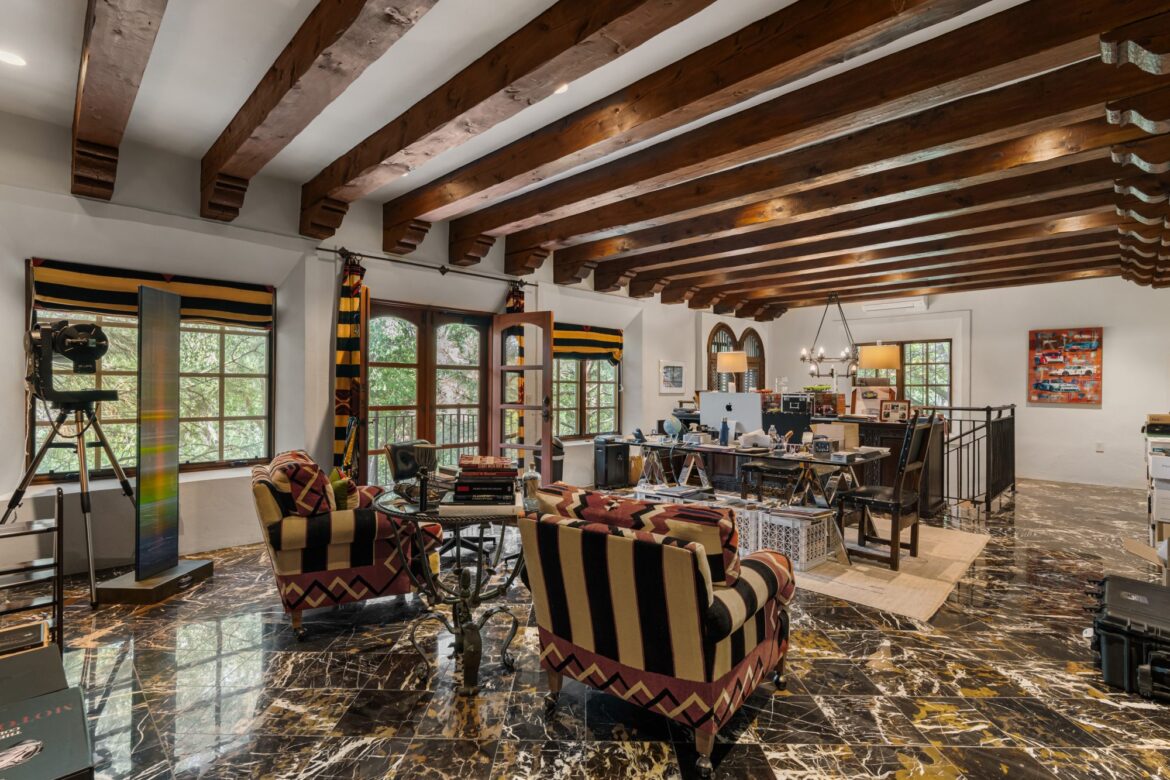
Its most consequential stewards arrived next: John and Ann Marion. John was the former chairman of Sotheby’s; Ann came from the Burnett Foundation of Fort Worth, Texas, whose Four Sixes Ranch later became familiar to television audiences through the Yellowstone universe. Anne Marion, described by Webster as a collector with one of the finest private art collections in the country, restored the house to what he calls a state of perfection, commissioning craftspeople such as Tom Joyce, a MacArthur Fellowship–winning ironworker, to create custom wrought-iron railings and gates. She added little in the way of new construction; her focus was restoration, embellishment, and materials and craftsmanship at the highest level.
Premium Collections
When the Marions eventually sold, the buyer – Fran Mullin, the former chairman of Canada Dry and later Dr. Pepper/Seven Up – took the house essentially as he found it. Ann Marion had cataloged the home’s furnishings in a leather-bound book, itemized and appraised by Sotheby’s art specialists, with an offer to buy everything at half price. Mullin, Webster says, looked at the book for less than a minute before deciding to take it all, buying the estate fully furnished and turnkey.
After roughly fourteen years, the Mullins relocated to be near family in Atlanta, and the house passed to another couple, who added a showcase garage with glass walls looking into an adjoining office, positioned so that a collection of high-performance cars is visible from the desk. Below that addition sits a music studio, a theater, and a bar with powder rooms. The couple also built a wine cellar beneath the primary suite, finished with a brick, vaulted ceiling in the style of Mexican cellars, carved wood shelving, and 30-inch antique marble floor tiles imported from France.
Maximum Intimacy
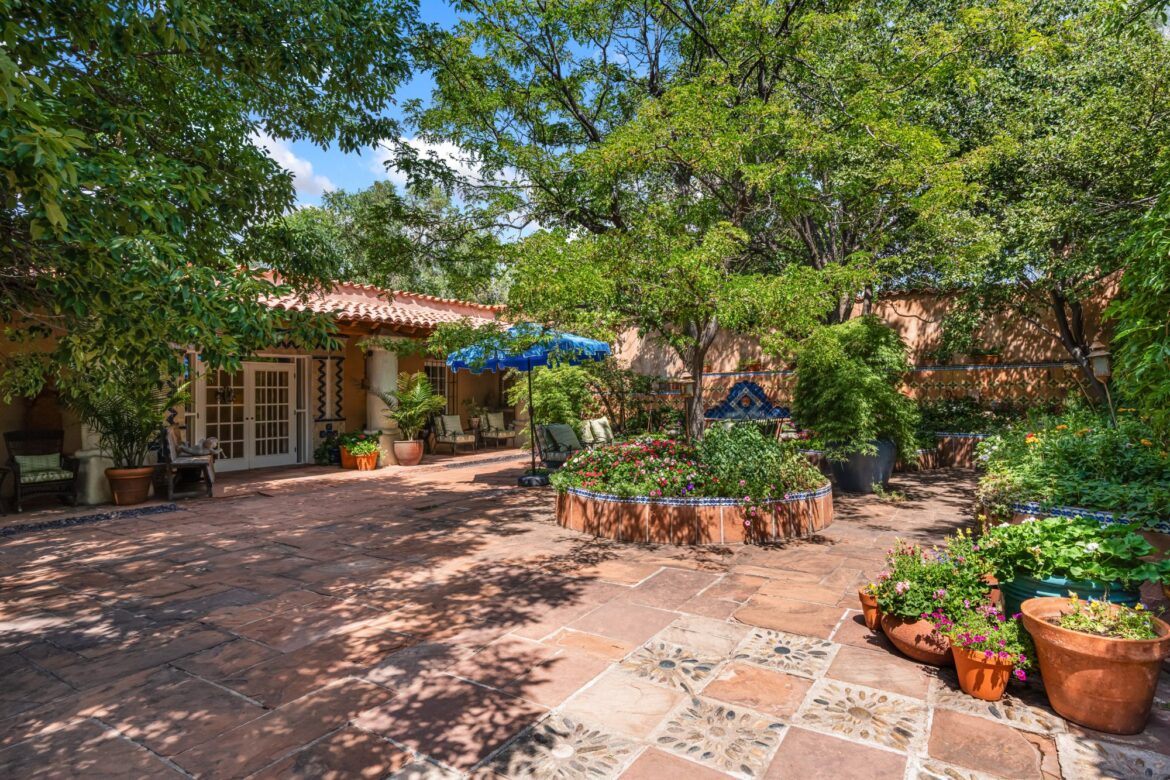
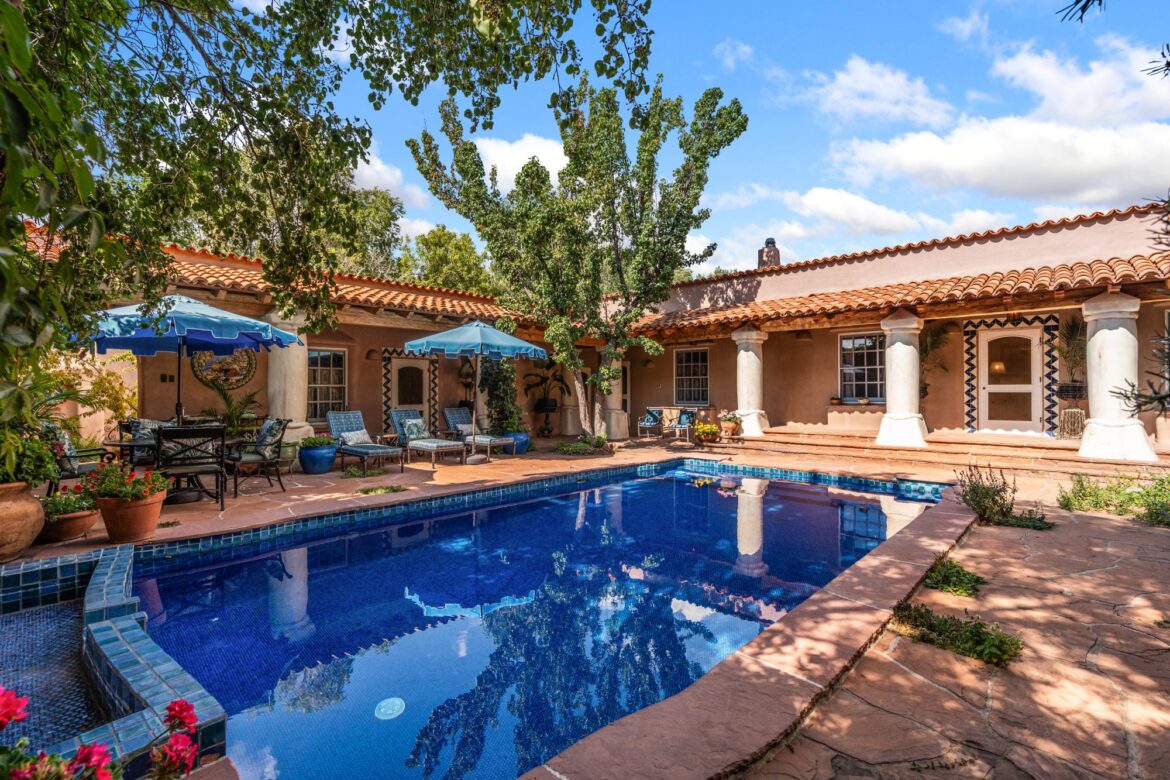
Although the house measures roughly 9,600 square feet, visitors consistently describe the property as feeling intimate rather than sprawling. The floor plan helps explain why: a one-bedroom main house is flanked by three attached but independent guest casitas, one with its own living room, dining area, and kitchen. Courtyards, portals, and outdoor rooms break the property into a series of smaller, human-scaled spaces rather than one continuous expanse.
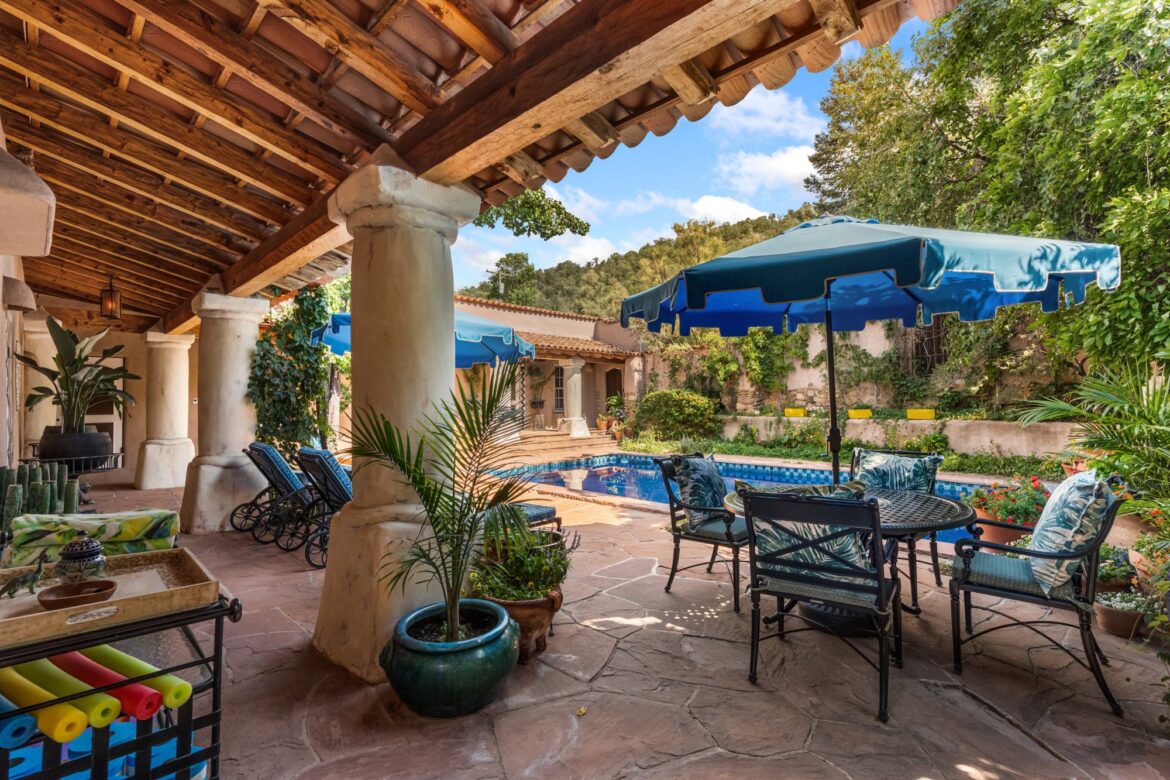
The entry courtyard, fountained and tree-shaded, sits behind a massive pedestrian-and-horseback gate. On the river side, the courtyard includes a pool with its own fountain and waterfall, while balconies off the primary suite look directly over the Santa Fe River, more than 250 feet of frontage, with the sound and sight of moving water audible from inside the house. Niches built into the walls hold antique blue European tile, and manicured gardens extend from the terraces down toward the water.
The house’s address is part of its identity. Upper Canyon Road is one of Santa Fe’s most storied streets, and the property’s walled privacy – total seclusion once through the gates, despite sitting in the middle of the city – is unusual for its location. Santa Fe’s climate is part of the pitch as well: roughly 325 days of sunshine a year, mild summers, and an environment Webster describes as one that constantly draws residents outdoors, whatever the season.
On the Market
Cason del Triunfo is currently listed for $9.5 million, a price point Webster notes is well above where most Santa Fe properties top out, a market that, outside of exceptional estates, generally caps around $5 million to $6 million. At that level, he says, a property has to offer something genuinely extraordinary, whether architectural significance, acreage, or both. Cason del Triunfo’s combination of pedigree, craftsmanship accumulated across nine decades, and river frontage on one of the city’s most desirable streets places it in that rarefied tier.
About the Expert: Chris Webster is the Broker/Owner of Webster Estates, Sotheby’s International Realty, in Santa Fe, New Mexico, where he specializes in Santa Fe and northern New Mexico estate, ranch, and commercial properties, as well as historic haciendas in Mexico and resort properties in Hawaii and western Europe. He also serves as CEO and Publisher of Leading Estates of the World.
This article is intended for informational purposes only and does not constitute legal, financial, or investment advice. The views and opinions expressed herein reflect those of the individuals quoted and do not represent an endorsement of any company, product, or service mentioned. Readers should conduct their own due diligence and consult qualified professionals before making any investment decisions.


